How to Set Up a Mobile Digital Mammography Unit for Community Screenings
Setting up a mobile digital mammography unit requires integrating a specialized digital mammography system with a heavy-duty medical vehicle chassis, dedicated radiation shielding, and an uninterruptible onboard power supply. This mobile approach allows healthcare providers and public health organizations to bring early diagnostic imaging directly to underserved communities, industrial campuses, and rural clinics without stationary radiology facilities.
Community-based preventive outreach plays a crucial role in improving early cancer detection rates. By converting healthcare delivery from fixed hospitals into specialized Medical Vehicles, organizations can overcome geographical barriers, optimize patient screening numbers, and enhance regional public health initiatives.
Essential Vehicle Design and Space Planning for a Mobile Digital Mammography Unit
Transforming a vehicle into a fully functional radiology suite requires precise spatial ergonomics and structural engineering.
Layout and Structural Weight Distribution
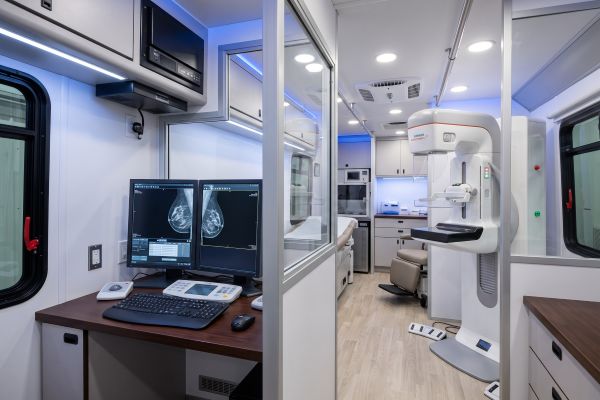
A mobile mammography coach generally incorporates three distinct functional zones: a reception/changing area, an examination suite, and a compact technical control booth. The primary gantry must be positioned directly over or near the vehicle chassis axles.
This balance is vital for maintaining vehicle handling, center-of-gravity stability, and safe weight distribution during road transit. In addition, soundproof sliding doors and climate partitions help maintain patient privacy and thermal comfort.
Radiation Shielding Standards for Mobile Units
Mobile units must adhere to the same stringent radiation safety standards as fixed hospital installations. Technicians and structural engineers line the exam room walls, ceiling, and access doors with specialized lead sheeting, typically equivalent to 1.5 mm to 2.0 mm of lead (Pb).
Lead-glass observation windows embedded in the control console protect the radiographer during exposure while preserving a clear line of sight to the patient.
Equipment Selection and Power Stability in a Mobile Digital Mammography Unit
Operating sensitive radiological hardware in a mobile environment requires robust component durability and reliable electrical architecture.
| Core System | Technical Requirement | Operational Function |
| X-ray Gantry & Detector | Shock-resistant digital flat-panel detector (FPD) | Resists road vibration during rural transit |
| Primary Power Source | Onboard low-noise diesel/gas generator | Provides off-grid electricity for remote fieldwork |
| Power Conditioning | True Online Double-Conversion UPS | Delivers pure sine-wave power and voltage stability |
| Climate Control | Dual-split HVAC with active dehumidification | Maintains optimal detector temperature ($20\text{–}25^\circ\text{C}$) |
| Data Connectivity | 4G/5G industrial cellular router & satellite | Transmits DICOM studies to centralized hospital PACS |
Shock-Resistant Digital Mammography Hardware
Road conditions during rural outreach subject medical imaging hardware to continuous mechanical vibration. Facilities must choose a digital mammography system engineered with reinforced mechanical locks and vibration-dampening mounting pads.
The digital flat-panel detector (FPD) and high-frequency X-ray generator must resist transit-induced alignment shifts to maintain accurate calibration and pixel integrity over long deployment cycles.
Generator and Online UPS Power Solutions
Unstable voltage from local rural grids or field generators can damage high-voltage X-ray circuitry. A reliable mobile unit relies on a high-capacity, low-emission onboard generator paired with an online double-conversion UPS (Uninterruptible Power Supply).
The UPS system filters electrical noise, regulates voltage fluctuations, and supplies immediate backup battery power during sudden generator cycling or shore-power disconnections.
Workflow and Mobile Data Management
High-throughput efficiency ensures the economic and operational feasibility of public health screening tours.
Patient Intake and Screening Throughput per Day
A streamlined mobile workflow separates administrative registration from image acquisition. While one patient undergoes exposure inside the shielded exam room, the next patient changes in the private forward cabin.
With standard 2D digital workflows, a well-coordinated two-person team (one radiographer and one administrative nurse) can complete 30 to 50 comprehensive bilateral examinations per operational day.
Wireless DICOM Image Transmission and Cloud PACS
Mobile outreach programs depend on swift data transfer to off-site radiologists for diagnostic reporting. Modern mobile units utilize multi-SIM 4G/5G industrial routers or low-earth-orbit satellite terminals.
Acquired DICOM studies transfer automatically from the local acquisition console to a central cloud-based PACS. Radiologists located at main hospital hubs can read images, generate structured diagnostic reports, and flag critical findings in near real-time.
Operational and Maintenance Best Practices
Consistent quality control ensures the long-term reliability of mobile diagnostic assets.
Daily Calibration and Temperature Control
Digital flat-panel detectors are sensitive to temperature extremes and humidity swings. Mobile operators must run automated daily quality assurance (QA) phantom checks and flat-field calibrations before launching patient intake.
Maintaining continuous climate control inside the vehicle prevents thermal shock to the detector scintillator layer. Technicians must also follow documented protocols for preventive maintenance to check emergency interlocks, mechanical brakes, and lead shielding seams periodically.
Practical Takeaways for Mobile Screening Projects
A well-engineered mobile digital mammography unit bridges the gap between urban medical centers and underserved populations. Success depends on combining a durable digital mammography system, compliant lead radiation shielding, resilient power conditioning, and an efficient cloud data workflow. Deploying reliable mobile screening infrastructure expands healthcare access while maintaining high clinical standards.
If you are planning to establish a community breast screening program or require customized Medical Vehicles equipped with complete digital X-ray solutions, contact our engineering team to discuss technical configurations and vehicle layouts.