Can Dynamic Digital Radiography Perform Quantitative Image Analysis?
Dynamic digital radiography can perform quantitative image analysis, but the extent of this capability depends directly on integrated analytical software rather than detector hardware alone. Conventional radiographic interpretation relies on qualitative visual inspection of morphological margins and tissue density. In contrast, quantitative image analysis extracts measurable numerical metrics from dynamic data arrays. Dynamic DR enables this computational evaluation by recording consistent, time-stamped radiographic projection series throughout physiological motion. Consequently, medical facilities can evaluate kinematic metrics objectively to support diagnostic decision-making.
Dynamic Image Sequences Provide Data for Measurement
Every sequential projection frame acquired during dynamic digital radiography carries precise temporal and spatial metadata. Linking these consecutive planar projections creates a structured temporal matrix that tracks structural displacement over time. Because exposure pulse intervals remain fixed, automated algorithms can calculate physical motion rates with high repeatability.
From these continuous data series, analytical tools extract essential kinematic variables. These foundational parameters include structural trajectory, linear displacement, peak excursion velocity, and total movement duration. Transforming qualitative visual observation into discrete physical values establishes reproducible baselines for longitudinal patient tracking. Dynamic DR provides the standardized raw imaging stream required to compute these spatial-temporal measurements accurately.
Motion Pattern Evaluation Using Dynamic Digital Radiography
Applying analytical software to dynamic projection sequences allows clinicians to evaluate physiological motion patterns systematically. In thoracic imaging, dynamic digital radiography evaluates respiratory biomechanics across entire breathing cycles. Analytical algorithms measure vertical diaphragmatic excursion, track rib cage expansion distances, and identify asymmetric movement between lung fields. Quantifying these motion differences across multiple phases assists clinicians in assessing localized functional restrictions.
In musculoskeletal applications, the technology measures functional range of motion under active physical loading. Software models track bony landmarks across frame series to quantify joint angle transitions, patellar shift distances, and articulation speeds. Detecting subtle kinetic discrepancies between anatomical resting states and peak stress positions provides valuable supplementary insight. These numerical findings assist medical teams in monitoring rehabilitation progress, evaluating structural stability, and planning surgical interventions.
| Clinical Target Area | Measurable Kinematic Metrics | Diagnostic Support Value |
| Thoracic & Diaphragm | Excursion distance, contraction velocity, tidal timing | Objective assessment of ventilatory dynamics and restricted motion |
| Orthopedic Articulations | Angular displacement, joint space shift, movement velocity | Dynamic stability quantification and postoperative joint tracking |
| Analytical Output | Time-displacement curves, region of interest metrics | Standardized datasets replacing subjective visual estimation |
Software Determines the Depth of Quantitative Analysis
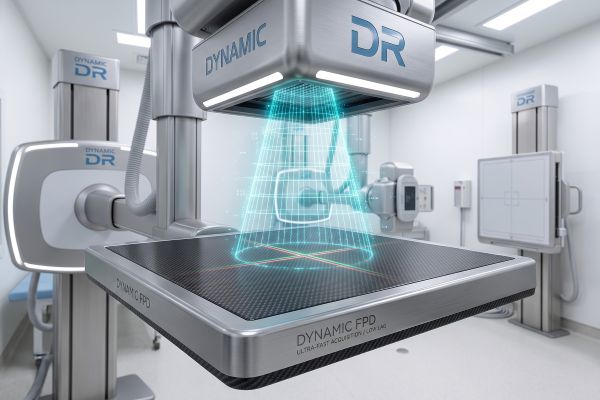
While flat-panel hardware captures raw pulsed frames, software algorithms govern the sophistication of quantitative evaluation. A high-specification detector alone does not guarantee comprehensive diagnostic metric extraction. Healthcare buyers evaluating dynamic digital radiography systems must investigate dedicated software modules and computational toolsets thoroughly.
Key software features include automated region of interest (ROI) segmentation, dynamic edge tracking, and synchronized displacement curve generation. Facilities should also verify raw data export options (such as CSV or DICOM structured reporting) to facilitate clinical research and third-party analysis. Because analytical capabilities vary considerably between commercial dynamic digital radiography platforms, clinical administrators must select software configurations aligned with departmental diagnostic goals.
Conclusion
Dynamic digital radiography successfully supports quantitative image analysis by converting sequential X-ray exposures into objective kinematic data. This numerical output supplements conventional visual inspection with measurable parameters across respiratory and orthopedic evaluations. However, overall analytical depth depends on specialized software architectures and processing options selected by the facility.
Contact our technical specialists today to review software capabilities or request a product demonstration.