What Frame Rate Is Needed for Dynamic Digital Radiography?
There is no universal frame rate for dynamic digital radiography, as the ideal acquisition speed depends on anatomical movement velocity, the specific diagnostic question, and flat-panel detector readout capabilities. While capturing continuous motion requires rapid sequential imaging, setting frame rates involves balancing physical motion tracking with radiation exposure limits. Dynamic DR measures cadence in frames per second (fps), representing temporal sampling frequency rather than pixel density or static sharpness. Consequently, radiology teams determine optimal capture speeds by aligning procedural goals with the physical rate of anatomical movement, ensuring sharp motion tracking without over-sampling slow physiological events.
What Does Frame Rate Mean in Dynamic Digital Radiography?
Frame rate defines the frequency of discrete image acquisitions recorded per second, expressed as frames per second (fps). Within dynamic digital radiography, this value governs how smoothly an active physiological process translates into a continuous digital cine loop.
- Frames Per Second (fps): Quantifies raw acquisition sampling speed over a one-second interval.
- Pulse Width: Dictates individual exposure duration per pulse, directly freezing rapid mechanical displacement.
- Temporal Resolution: Reflects the combined capacity of frame rate and pulse duration to resolve motion without blur.
While higher frame rates yield fluid playback and capture rapid structural transitions, they do not dictate spatial clarity or contrast resolution. An acquisition running at high speed can still display heavy quantum mottle if photon delivery is restricted, demonstrating that frame rate acts as a temporal sampling parameter rather than an overall measure of image quality.
Different Examinations Require Different Frame Rates
Different clinical examinations exhibit widely disparate kinetic profiles, requiring facilities to tailor acquisition cadences to the target anatomy rather than using a single default setting.
Thoracic procedures—such as tracking diaphragmatic excursion and chest wall mechanics—involve smooth, rhythmic movement. Because a typical breathing cycle unfolds across several seconds, moderate acquisition rates provide thorough kinetic assessment without producing excessive image frames. Conversely, dynamic orthopedic studies require different configurations. Slow, active joint bending can be captured effectively at modest speeds, whereas rapid stress testing or ligamentous subluxation evaluation benefits from elevated sampling rates to avoid losing diagnostic edge definition. Imaging facilities establish these protocols based on anatomical velocity rather than pursuing arbitrary high numbers.
| Anatomical Focus | Kinetic Motion Profile | Sampling Objective | Typical Protocol Requirement |
| Pulmonary & Diaphragm | Rhythmic, continuous breathing cycles | Tracking ventilatory shifts and border excursion | Moderate cadence preserving low cumulative exposure |
| Weight-Bearing Joints | Controlled flexion, extension, and rotation | Assessing articular surface contact and alignment | Adaptable rates matched to patient movement speed |
| Rapid Swallowing Phases | Fast bolus transit through oral pharynx | Freezing bolus propulsion and detecting aspiration | Higher acquisition speeds to avoid temporal blur |
How Does Frame Rate Affect Image Quality and Radiation Dose?
Selecting an acquisition cadence in dynamic digital radiography requires balancing temporal visibility against data storage demands and cumulative patient exposure.
Higher frame rates record fine kinematic details, but they also multiply data burdens. A high-fps sequence creates dense cine datasets that challenge PACS bandwidth, archive storage, and workstation processing speeds. Furthermore, each added frame represents an additional radiation pulse. Although modern systems use short micro-pulses with reduced per-frame exposure, extending continuous high-cadence runs over several seconds naturally increases cumulative radiation. Clinical teams must balance temporal fidelity, image noise, and the ALARA principle to prevent excessive patient exposure.
How Does Frame Rate Affect Motion Representation?
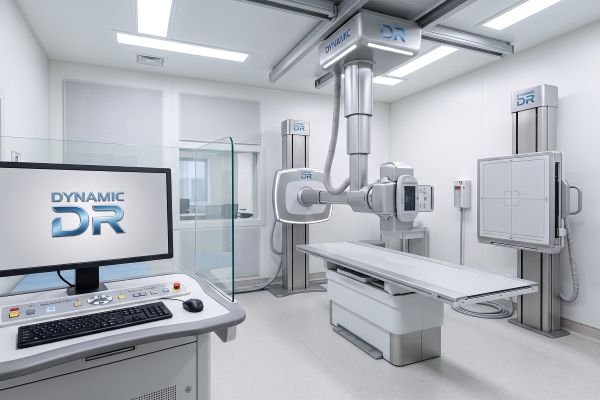
Acquisition speed directly determines how faithfully continuous anatomical motion translates into a clinical cine sequence. Because human movement unfolds continuously rather than in discrete intervals, dynamic digital radiography uses rapid image pulses to approximate fluid mechanical displacement.
If an acquisition runs at an inadequate cadence, the resulting playback appears disjointed, causing brief but diagnostically significant kinetic shifts to slip past unrecorded. In fast physiological events—such as rapid joint snapping or swallowing reflex phases—a sluggish capture speed skips critical intermediate positions entirely, leaving gaps in the biomechanical record. This challenge highlights the role of temporal sampling: the X-ray detector must sample the movement fast enough to capture subtle velocity shifts without introducing stutter.
However, capturing smooth motion involves more than just selecting an arbitrary frame count:
- Frame Rate: Represents the total number of distinct sampling points recorded per second.
- Temporal Resolution: Reflects the imaging chain’s true capacity to differentiate two closely spaced mechanical states in time.
- Exposure Duration: Dictates how sharply each individual pulse freezes motion blur on moving structural edges.
A high frame rate improves playback fluidity across a sequence, but short individual exposure pulses are what actually prevent blur along moving anatomical borders. Selecting an appropriate cadence therefore depends entirely on the velocity of the targeted anatomy and the specific diagnostic question, rather than maximizing capture numbers without a clinical purpose.
Conclusion
The frame rate required for dynamic dr is governed by anatomical motion velocity, clinical diagnostic needs, and institutional safety protocols. Setting capture speeds should always focus on diagnostic utility rather than chasing peak numbers. Medical facilities evaluating dynamic digital radiography equipment should review operational frame rates across varied clinical modes, ensuring the system delivers clear temporal tracking and balanced radiation dosing across routine workflows.
Contact our technical imaging team today to discuss clinical imaging protocols and explore dynamic digital radiography platforms configured for your department.