Can Dynamic Digital Radiography Be Used for Gastrointestinal Imaging?
Dynamic digital radiography can be used for gastrointestinal imaging in targeted clinical scenarios where observing luminal transit and physiological motility is essential. While conventional static radiography captures detailed mucosal structure at a single moment, gastrointestinal diagnostics frequently require tracking continuous movement over time. Dynamic digital radiography records sequential low-dose X-ray projections throughout active digestive processes, adding critical temporal information to standard planar views. Consequently, medical facilities employ this modality to evaluate functional kinetics and structural changes without resorting to continuous fluoroscopy for every dynamic phase.
Dynamic Digital Radiography Can Capture Gastrointestinal Motion
Gastrointestinal motility is inherently time-dependent, characterized by coordinated muscular contractions that cannot be fully assessed on isolated still images. Evaluating these processes requires imaging technology that captures continuous physiological displacement.
Dynamic DR addresses this need by acquiring high-frame-rate pulsed projections across targeted anatomical intervals. As peristaltic waves travel through the esophagus, stomach, or bowel loops, sequential frames record the progression of structural displacement. Comparing single-frame views with multi-frame dynamic sequences demonstrates a clear diagnostic distinction: static radiographs show static luminal geometry, whereas dynamic digital radiography visualizes muscular relaxation, bolus propulsion, and transient wall deformities in real time.
Dynamic Imaging Supports Selected Gastrointestinal Examinations
The ability to record continuous movement makes dynamic digital radiography particularly useful for specific contrast-enhanced gastrointestinal examinations. However, it serves as a focused clinical tool rather than a universal replacement for all fluoroscopic procedures.
During swallowing studies and upper digestive tract evaluations, clinicians administer radiopaque contrast agents to assess mucosal transit. Dynamic DR visualizes the rapid passage of barium through the pharynx and esophagus, enabling clinical teams to verify clearance direction, identify structural pooling, and detect dynamic aspiration events. Because these phases occur within brief, predictable windows, dynamic digital radiography captures the essential kinetic information while avoiding the continuous radiation output typical of conventional fluoroscopic screening.
| Examination Feature | Conventional Static X-ray | Dynamic Digital Radiography |
| Primary Data Output | High-resolution anatomical morphology | Continuous time-resolved motion sequence |
| Motility Tracking | Limited to post-transit accumulation | Real-time observation of contrast transit and wall motion |
| Clinical Diagnostic Focus | Mucosal lesions, calcifications, obstruction | Dynamic swallowing evaluation and functional peristalsis |
Image Quality and Acquisition Settings Determine Results
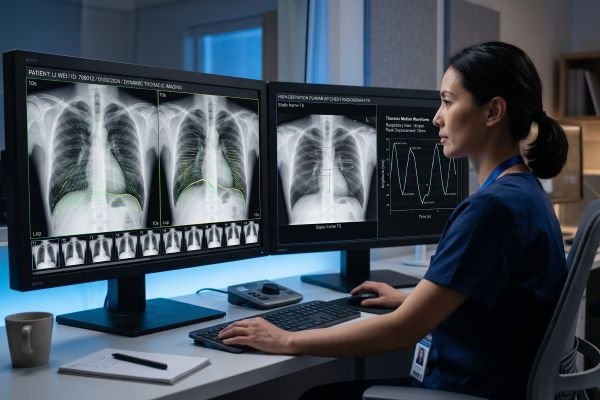
Achieving diagnostic image quality in gastrointestinal dynamic studies requires precise management of hardware specifications and exposure parameters.
Balancing spatial detail with high temporal resolution is critical. Rapid peristaltic and swallowing motions necessitate high-speed frame rates to suppress motion blur and prevent edge distortion across moving anatomical structures. Meanwhile, modern dynamic flat-panel detectors must maintain high detective quantum efficiency to ensure that rapid pulsed acquisitions deliver sufficient contrast definition without driving up cumulative patient radiation dose. Adjusting acquisition parameters to match the speed of targeted digestive movements ensures consistent diagnostic clarity.
Complementing Static Gastrointestinal Imaging
Dynamic DR functions alongside standard static examinations to create a complete diagnostic evaluation. Static radiographs remain the recognized standard for identifying subtle mucosal erosion, foreign body localization, and radiopaque calcifications.
Conversely, dynamic digital radiography provides the functional context that static projections lack. Combining high-resolution static baseline views with targeted dynamic motion sequences gives radiologists comprehensive diagnostic insight into both organ architecture and active motility. Implementing this hybrid approach enables healthcare facilities to address diverse gastrointestinal diagnostic challenges according to specific system configurations and departmental protocols.
Conclusion
Dynamic digital radiography can be utilized for selected gastrointestinal imaging examinations where evaluating real-time motion and contrast transit is essential. Its primary clinical value lies in adding the temporal dimension to conventional planar radiography, bridging the gap between static morphology and kinetic function. Institutional adoption ultimately depends on matching system performance and exposure configurations to facility clinical protocols.
Contact our technical imaging team today to discuss clinical protocols and explore advanced dynamic digital radiography options for your department.